
Every place is named for what it is
The Country of Hours. The Hall of Mirrors. The Slough of Debt. The Tower of Compounding. The allegory does not hide its meanings — it only leaves the application to you.
The deed was four lines long. An allegory of the whole of a life, in the lineage of Bunyan: a letter sealed with three sheaves of wheat called a factory hand named Hireling out of the City of Toil, and he learned that everything he carries is entrusted, not possessed.
To Hireling, dwelling in the City of Toil. The Master of the Estate has need of stewards. If you would be one of them, leave the city by the eastern gate before sundown. Bring nothing but yourself. Goodcounsel will meet you on the road.
Chapter One · The City of Toil

Steward's pilgrimage is not an escape from ordinary life — it is the long stewardship of one ordinary man's hours, body, mind, money, relationships, character, imagination, vocation, voice and unseen prayer, in the place he has already been put. He leaves the city by the eastern gate at dawn. The whole of the journey is for the sake of the return.
The Country of Hours. The Hall of Mirrors. The Slough of Debt. The Tower of Compounding. The allegory does not hide its meanings — it only leaves the application to you.
Factories, runners, ledgers, brass clocks, oil lamps. Miracles are absent. The Master appears once, in a body, and is recognised as such. Nothing here is glib, and nothing is sentimental.
It names the pressures by their names — overwork, debt, a grown child who has stopped writing, a neglected marriage, a neglected body, performance in church, panic on a screen — and takes them seriously.
Section VII · The Long Account · Chapter Three
“The Slough has three doors in.”
The book is published section by section, each one a country of the Road. One is in hand. The rest are written and scheduled — The Steward's Progress is complete in draft at eighty chapters, and the sections are being prepared for press in order.
No.
Country
Chapters
Status
A letter with an unfamiliar seal, and a bench a man has to stand up from.
5 ch.
In preparation
A workbench, ten tools, and a deed that turns out to cover the whole man.
4 ch.
In preparation
Two clocks that do not agree, a device strapped to the wrist, and the day that is kept.
9 ch.
In preparation
The body and the mind, treated not as vehicles for the soul but as the thing itself.
6 ch.
In preparation
Seven mirrors, a city where everyone dresses alike, and a near-miss at a fountain.
6 ch.
In preparation
Lamplit windows, a friend, a graveyard of unsent letters, and the nearest cord left open.
7 ch.
In preparation
The plain, the slough, the tollhouse, the hill, the tower, the garden — and the bank where the whole Road is reckoned.
8 ch.
Class Edition
Four gates, and the reforming of everything the world now means by purpose.
10 ch.
In preparation
A craftsman, a block of walnut, a knife — and cynicism standing in the doorway.
5 ch.
In preparation
A village of many doors, where the gifts are counted and not one of them is ranked.
7 ch.
In preparation
Two towns and two voices — and a third door that most travellers never open.
6 ch.
In preparation
The road turns north, and everything a steward has carried is finally read back to him.
6 ch.
In preparation
Plus an Epilogue — The Bench, and the Last Word
The Road in full →Section I · The Calling · Chapter One
In the City of Toil, the air was thick with the smoke of forges and the noise of machines.
Hireling rose before dawn, as he had every dawn, and joined the gray procession to the factory gate. He worked. He earned. He spent. He lay in the dark. And he rose, and did it all again.
It was not an evil city. Its streets were straight. Its taxes were paid. On Sundays the bells rang and many of its citizens, Hireling among them, walked to one of the city's churches and sat through the service and walked home again. The pastor preached well enough. The hymns were known by heart. After lunch Hireling would lie down for an hour, and then it was Monday and the factory bell was ringing.
There is a thing a man strikes in the morning. Older men called it the flint of the day. A man wakes; he reaches for the small bright spark that pulls him out of the bed and sets the day alight. Hireling had struck his flint each morning and found no tinder. The hand went through the motion but the fire did not come. He rose because the bell rang, not because he had anything to set alight. He had forgotten that the flint was supposed to catch.
This is the most important thing to understand about the City of Toil. It does not destroy its inhabitants. It does not need to. It only keeps them busy enough that they forget to ask what they are being kept busy for.
Excerpt · Chapter One of eighty
Keep reading — the letter, the doubt, and the deed →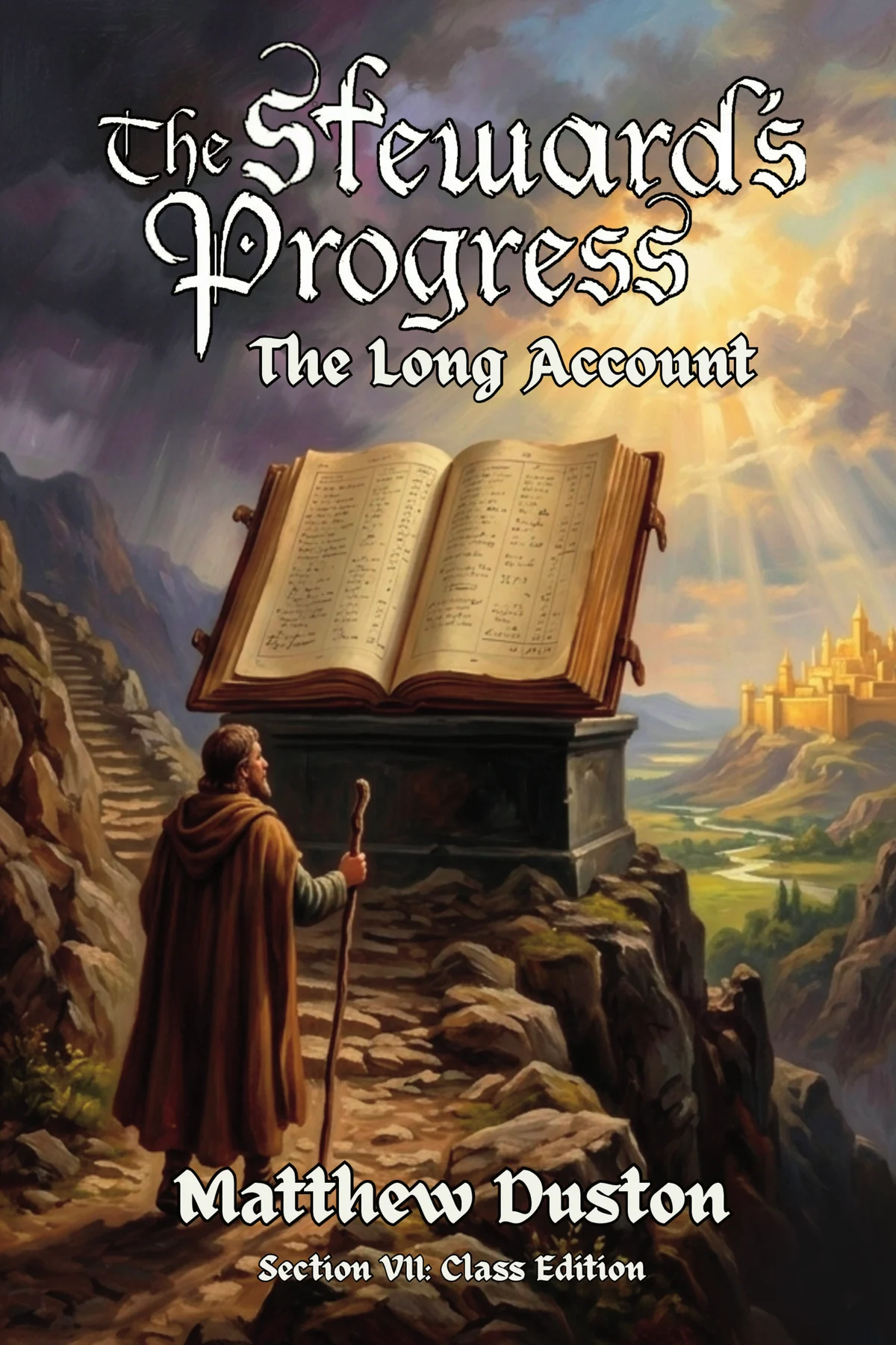
Section VII · the first section in print
One man's whole life, walked as a road. The Steward's Progress runs eighty chapters through twelve countries — the hours, the body, the mind, the money, the people, the character, the imagination, the work, the voice, and the prayer no one hears. It is complete in draft and is being prepared for press one country at a time.
Each section stands on its own and is read in order. What holds them together is the deed signed in the first: Mine. Yours to manage. Account given. Reward kept.
Each one a province of an ordinary life, named for what it is.
The whole road is written. The sections go to press in sequence.
Book, chapter and verse only — a door, not an assignment.
Every section carries a course, for groups that want to walk it together.
First in print: Section VII, The Long Account — the Country of Coin. The plain, the slough, the tollhouse, the hill, the tower and the garden: what a wall is for, why the first portion stands first, and which ledger is the only one that follows a steward out. The remaining eleven are written and scheduled; see the route board above.
Each section of the book carries its own course: its chapters paired one to one with weeks, the story doing the teaching and the workbook holding the walking. The book keeps you inside the country — the course puts you back down in your own kitchen. The shape below is the same for all twelve; the first one built is Walking the Long Account, for Section VII.
Vol. I
The section's chapters, with scripture references at the foot of every page. Read the week's chapter before the group meets.
Vol. II
Where the walking happens — the Daily Walk, One Stone a week, the working pages, and a lexicon that gives every term its plain-words twin.
Vol. III
The leader's edition. The teaching is scripted word for word, so a first-time leader never has to improvise the wording that matters.
One course exists today — Walking the Long Account, eight weeks on Section VII. The other eleven follow their sections to press.
Parts of this book are built to be heard. The four glances and the four words of the deed work liturgically — they were written for the ear before the eye.
A full narration of Part One is in production: forty-nine speaking parts, each with its own voice, and a second, deeper voice kept for the Adversaries so that the two are never confused. It runs to roughly nine hours.
The recording is not finished and is not yet for sale. Ask to be told when it is.
One letter when a section goes to press, when the course opens, and when the narration is finished. Nothing else.