
The Steward's Progress Three Sheaves Press

The opening

This is how the book begins — the city, the bench, and the flint that no longer catches — and then, five chapters on, the four lines a man signs at the gatehouse. Two chapters of eighty are published here. The rest of the road goes with the book.

Section I · The Calling · Chapter One

The City of Toil

In the City of Toil, the air was thick with the smoke of forges and the noise of machines.

Hireling rose before dawn, as he had every dawn, and joined the gray procession to the factory gate. He worked. He earned. He spent. He lay in the dark. And he rose, and did it all again.

It was not an evil city. Its streets were straight. Its taxes were paid. On Sundays the bells rang and many of its citizens, Hireling among them, walked to one of the city’s churches and sat through the service and walked home again. The pastor preached well enough. The hymns were known by heart. After lunch Hireling would lie down for an hour, and then it was Monday and the factory bell was ringing.

If you had asked him whether he was happy, he would have shrugged. The question would have struck him as foreign. He was paid. His rent was paid. He had a coat for winter and a coat for spring. His neighbors knew his name. His foreman knew his name. The pastor knew his name, more or less. Once a year he was given a small bonus, and once a year a small reprimand, and the bonus and the reprimand together kept him steady at his bench.

There is a thing a man strikes in the morning. Older men called it the flint of the day. A man wakes; he reaches for the small bright spark that pulls him out of the bed and sets the day alight. Hireling had struck his flint each morning and found no tinder. The hand went through the motion but the fire did not come. He rose because the bell rang, not because he had anything to set alight. He had forgotten that the flint was supposed to catch. He thought a man’s mornings were all sparks and no fire, the way a man’s bread was thin in winter and a man’s coat was patched at the elbow. He thought it was the weather of being alive.

Hireling paused at his bench, his hands resting on the heavy iron machinery as a strange, unbidden thought of the open sky crossed his mind.

The Foreman: Tisk, tisk, tisk, Hireling.

Hireling turned. The Foreman stepped out of the gray smoke, carrying his heavy clipboard. Hireling looked up and met his eyes, they were completely still, cold, and calculating. It was the look of a man appraising the slaughter weight of cattle or the liquidation value of a bankrupt estate. The Foreman did not see a man; he saw a mechanism failing to produce.

The Foreman: Idle hands and wandering thoughts are against company policy. The quota is waiting.

Hireling lowered his head, the brief spark fading.

The Foreman: (Smiling smoothly) That is better. Keep your head down. There is always tomorrow to think about the sky. Today, we work.

This is the most important thing to understand about the City of Toil. It does not destroy its inhabitants. It does not need to. It only keeps them busy enough that they forget to ask what they are being kept busy for.

On a Tuesday no different from any other, a letter waited for Hireling at his door.

He saw it as he came home in the gray hour after the shift’s end. It lay on the threshold, weighted by a small stone someone had set on its corner so that it would not blow away. Hireling stooped, took it up, and turned it in his hand.

The seal was unfamiliar. A crest of three sheaves of wheat over an open hand, pressed in red wax. He had seen no such crest in his life.

He went inside, set the letter on his table, lit the lamp, and read.

To Hireling, dwelling in the City of Toil. The Master of the Estate has need of stewards. If you would be one of them, leave the city by the eastern gate before sundown. Bring nothing but yourself. Goodcounsel will meet you on the road.

Hireling read it three times. He turned it over. There was nothing on the back. The script was steady and careful, written by a hand that had written many such letters and was not in a hurry.

He showed it first to his neighbor, who came over from across the hall when Hireling tapped at his door.

Neighbor: (Leaning over the table) What does it say?

Hireling: Read it for yourself.

The neighbor read. Then he laughed, not unkindly.

Neighbor: Hireling, you are too sensible for nonsense. Master of what estate? The factory will be open in the morning. Your bench will be there. The wages will be there. This is some prank of a clerk in town. Throw it in the fire and stay for cards.

Hireling did not throw it in the fire. He put it in his coat pocket and returned home.

The next morning, he showed it to The Foreman.

The Foreman read it standing at his desk, in a hurry, with one eye on the floor where the men were already at their stations. He laughed too, but his laugh was harder.

The Foreman: (Handing the letter back without looking at it twice) Hireling, the city pays steady wages. The road pays nothing. Listen to me. I have seen three men in my time take up letters like that. None came back better off. One came back. One died on the road. One was never heard from again. You have a coat and a bench. Be sensible.

He had already turned back toward the floor. As Hireling moved to go, the Foreman spoke once more, not bothering to look up.

The Foreman: The bench will be here tomorrow, Hireling. It is always here. Men wander off and men come back; the bench does not notice the difference. I will see you in the morning.

Hireling thanked him and folded the letter again. He put in a full day’s work.

At dusk he walked home in the gray procession. He took the letter out and read it once more.

The script had not changed. The eastern gate was a half-hour’s walk.

He folded it, set it on the table, and went to bed.
Chapters Two to Four are not printed here

Section I · The Calling · Chapter Five

The Gatehouse and the Deed

On the seventh day from the City of Toil, the road narrowed.

The trees on either side, which had been mixed and varied, gave way to a single kind of tall straight pine. The path rose. The path narrowed further. By midmorning he was walking on what could no longer be called a road at all. It was a stone path, cut into the side of a low rise, wide enough for one man.

The path ended at a great wooden door set in a wall of weathered stone.

Hireling stopped.

There was no sign on the door. There was no bell. There was only the door, and the wall, and on either side, the pines, and behind him, the narrow stone path.

He stood for some time. He did not know whether to knock or to wait.

At last he raised his hand to strike the door once.

Before his palm could fall against the wood, the door opened.

Inside, in a hall lit by a single lamp, stood a tall man in a steward’s tunic. His face was kind but unhurried. Behind him the hall opened onto a long room, and beyond that, glimpses of more rooms, and from somewhere within, the small sounds of a household at its work.

The Steward of the House: You are Hireling. The Master is expecting you. Come.

Hireling stepped through. The door closed behind him with a quiet weight. He had the sudden sense, though no one had said so, that the door would not open the same way for him again. He was no longer outside. He was inside, and he had come in.

The man led him down the hall to a long table on which lay a single document, sealed in red wax with the Master’s three-sheaves crest.

The Steward of the House: This is your deed. Read it before you sign.

Hireling broke the seal.

He had expected, in some half-formed corner of himself, a transfer of property. Land, perhaps. A sum of coin. A title. Some object that would change his standing in the eyes of others.

The deed contained four lines, written at the top of an otherwise blank page in red ink.

Mine.

Yours to manage.

Account given.

Reward kept.

Below those four lines, the document detailed an inheritance: a portion of the Master’s estate, with all its lands, beasts, monies, and people, placed under Hireling’s management.

He read it twice. He looked up.

Hireling: I am to manage this? It is not given to me?

The Steward of the House: Given to your care. Not given to your possession. Many men come to this table thinking the Master will make them rich. He has done better than that. He has made you trusted. The first lie this road will tell you is that what you carry is yours. Refuse it, and the rest of the journey is half won.

Hireling stared at the four lines.

Hireling: (Slowly) What does it mean, that the account is given?

The Steward of the House: It means the Master will return. He will ask what you did with what He gave. He will not ask what you would have done if you had had more. He will ask what you did with what you had.

Hireling: And the reward?

The man smiled, for the first time. It was a smile that surprised Hireling for being warm.

The Steward of the House: The reward is kept. Not earned. Kept. The Master keeps it for those who manage faithfully. He has never failed to give it.

Hireling looked at the document. He looked at the pen, which had been placed beside it. He thought of the City of Toil and the gray procession. He thought of The Foreman’s three men. He thought of the friendly stranger at the crossroads, who had spoken so easily of the southern road. He thought of the satchel hanging from the oak branch and of the quiet old man who had been there when he came around the bend, as if he had always been there, as if he had been waiting since before Hireling had been born.

He thought of his hands, which were the hands of a factory worker, and of the deed, which was the kind of document he had never in his life imagined signing.

He took the pen, signing his name beneath the Master’s seal.

The pen scratched across the paper, ordinary as any pen, in a hand that was no different from the hand he had used yesterday and the day before. The signature, when he looked at it, looked like the signature of a man named Hireling. It looked like a signature he had written on a hundred forms at the factory.

But the moment of the signing did something he had not expected. It did not change his hand. It did not change the room. It did not change the pen, or the deed, or the seal, or the table, or the man in the steward’s tunic standing beside him. It changed the air, or him, or both.

The man in the steward’s tunic addressed him by a new name.

The Steward of the House: Rise, Steward. Welcome to the trust.

Steward did not feel different. He felt, in a way he could not have explained, more himself than he had been minutes before. He folded the deed carefully and put it into the inside pocket of his coat, where the letter had been, and which he found now to be empty. He did not remember taking the letter out. He suspected, without knowing how, that the letter had done its work and gone wherever such letters go when their work is done.

The sample ends here, a few lines into the orientation hall. Eleven countries and seventy-five chapters follow — the hours, the body, the mirrors, the cords, the long account, and what is asked at the end of the road.

Be told when the first section goes to press →
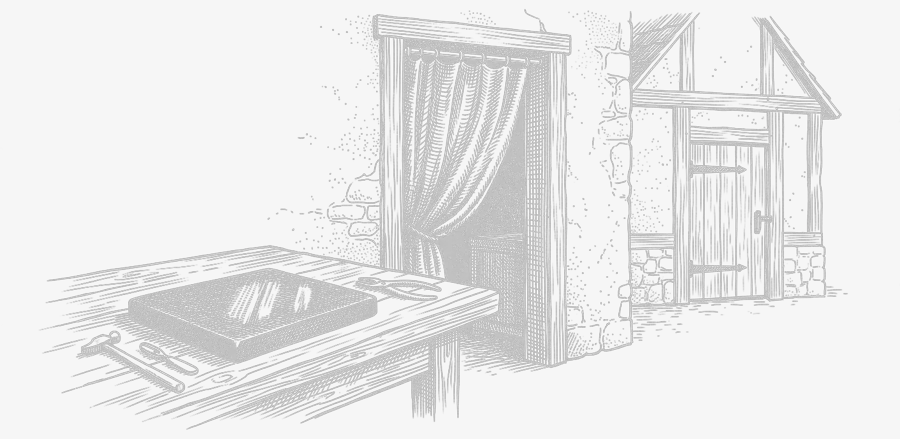
A steel engraving from the Country of Coin: a tollhouse on the road.

Section VII · The Long Account · Chapter Four

The tollhouse, and what it asks a traveller to sign.

Walk the route board

Twelve countries lie between this page and the high ridge. See where the road goes — without being told what happens on it.